CFS
Descaler
Industrial-strength phosphoric acid descaling concentrate. Dissolves calcium scale, lime deposits and mineral fouling in marine and industrial systems.
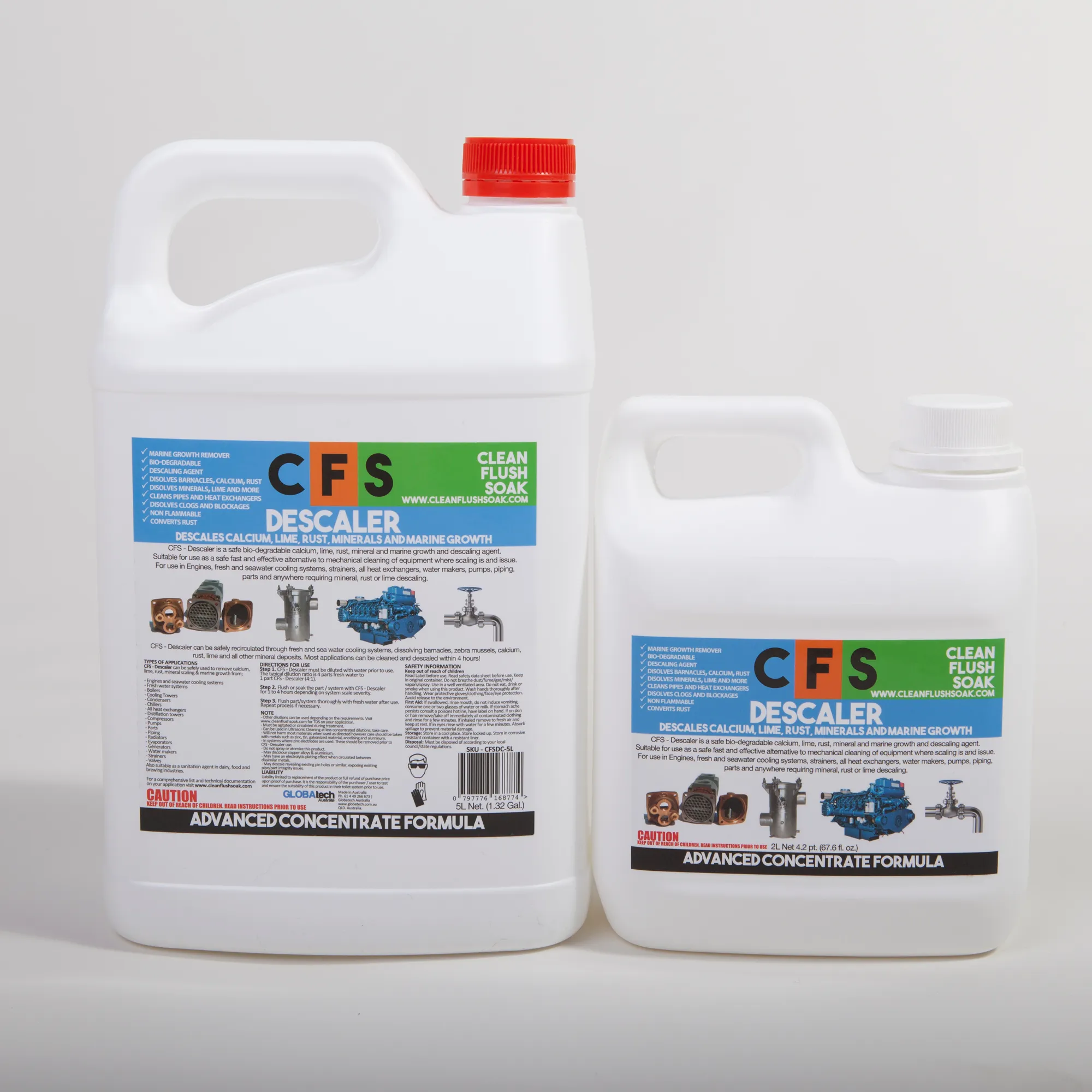
What It Does
CFS Descaler is a concentrated phosphoric acid-based descaling solution engineered for the removal of calcium carbonate, lime scale, mineral deposits and light rust from marine heat exchangers, box coolers, keel coolers, seawater pipework, watermakers and industrial process equipment.
The 4:1 concentrate ratio means one litre of CFS Descaler produces five litres of ready-to-use descaling solution — significantly reducing freight costs and storage requirements versus ready-to-use alternatives.
Phosphoric acid's unique action not only dissolves scale — it simultaneously passivates ferrous metal surfaces, leaving a thin iron phosphate conversion layer that provides short-term corrosion protection after treatment.
- RTU is Non-DG Ready-to-use dilution is Non-DG classified — ships as general freight by air, sea or road. Concentrate is classified as DG. Refer to SDS for full transport details.
- 4:1 Concentrate Economy One 20L drum treats the same volume as 80L of RTU product — reducing freight, storage and cost.
- Broad Material Compatibility Safe on titanium, stainless steel, copper alloys, fibreglass and most elastomers at working concentrations.
- Biodegradable Inhibitor Package Proprietary corrosion inhibitor blend protects system metals during the descaling process.
- Australian Made Formulated and manufactured in Queensland, Australia.
Product Data
| Parameter | Value | Notes |
|---|---|---|
| Active Acid | Phosphoric acid (H₃PO₄) | Food-grade source |
| Concentration | Concentrate — dilute 4:1 (water) | 1 part product + 4 parts water |
| Appearance | Clear amber liquid | — |
| pH (concentrate) | <1 | — |
| pH (working solution) | ~1.5–2.0 | At 4:1 dilution |
| Specific Gravity | ~1.15–1.20 | Concentrate |
| Transport Classification | See current SDS | Depends on product version and dilution |
| Signal Word (SDS) | WARNING | GHS07 |
| Shelf Life | 24 months | Sealed, out of direct sunlight |
| Storage | 5–40°C | HDPE or SS containers |
| Country of Origin | Australia | Made in Queensland |
Where CFS Descaler Works
Marine Heat Exchangers
Plate heat exchangers (PHE), shell & tube, APV and similar types. Circulation cleaning via pump or portable recirculation unit.
Box Coolers & Keel Coolers
Scale removal from sea water-side of box cooler arrays. Compatible with titanium and cupro-nickel tube materials.
Seawater Pipe Systems
Flush descaling of seawater intakes, overboard discharge lines and saltwater systems aboard vessels.
Watermakers & Desalination
Pre-treatment and maintenance descaling for reverse osmosis membrane systems and freshwater generators.
Industrial Process Equipment
Cooling towers, boiler condensate returns, process heat exchangers and industrial pipework in manufacturing and infrastructure.
Aquaculture Systems
Fish farm heat exchangers and seawater circulation systems where biological and mineral fouling accumulates.
How to Use
Shut off seawater supply and isolate the heat exchanger or circuit to be treated. Drain where possible.
Dilute CFS Descaler 4:1 with fresh water. For heavy scale, a 2:1 ratio may be used. Always add product to water, not water to product.
Circulate through the system using a portable pump at low flow rate, or fill and allow to soak for 1–4 hours depending on scale severity.
Bubbling or fizzing is normal — this is CO₂ released as calcium carbonate dissolves. When reaction ceases, treatment is complete.
Flush thoroughly with clean fresh water (minimum 2x system volume) before returning to service. Dispose of spent solution per local regulations.
Pack Sizes Available
Trial quantity / small system treatment. Suitable for single heat exchanger service.
Most popular format. Suitable for vessel system treatment or trade use.
For ship chandlers, service companies and regular commercial users.
Large volume for distributor stock, industrial facility or fleet operator use.
Product Documents
CFS Descaler FAQ
What type of acid is CFS Descaler based on?
CFS Descaler is a phosphoric acid (H₃PO₄) based descaling concentrate. Unlike hydrochloric acid descalers, phosphoric acid simultaneously dissolves scale and passivates ferrous metal surfaces, leaving a protective iron phosphate conversion layer.
Is CFS Descaler safe to use on titanium heat exchangers?
Yes. CFS Descaler is safe on titanium, stainless steel, copper alloys, fibreglass and most elastomers at working dilution (4:1). It should not be used on zinc, galvanised steel or aluminium without technical advice.
Is CFS Descaler classified as dangerous goods for shipping?
CFS Descaler concentrate is classified as dangerous goods (DG). The ready-to-use dilution (mixed at 4:1 with water) is Non-DG and ships as general freight. Always refer to the current Safety Data Sheet for full transport classification details.
How long does the descaling process take?
Most applications are completed in 1–4 hours depending on scale severity. Circulate the working solution using a portable pump, or fill and soak. Treatment is complete when the fizzing or bubbling (CO₂ release) ceases.
What is the dilution ratio for CFS Descaler?
The standard dilution is 4:1 — one part CFS Descaler to four parts fresh water. For heavy scale, a 2:1 ratio may be used. Always add product to water, not water to product.
How does CFS Descaler compare to hydrochloric acid descalers like Unitor?
Phosphoric acid descalers like CFS Descaler are less aggressive on equipment metals and provide a passivation benefit that HCl-based products do not. CFS Descaler also offers a favourable transport profile and 4:1 concentrate economy, reducing freight and storage costs significantly.